What Does AQL 2.5 Actually Mean for Your Footwear Order?
Last updated:
- September 15, 2026
Key Takeaways
- AQL 2.5 is a statistical sampling standard: it defines how many pairs an inspector pulls from your order, and how many defects are allowed before the batch is rejected.
- It does not mean 2.5% of your shipment will be faulty. It means the inspection is calibrated to reject a batch whose true defect rate exceeds roughly 2.5%.
- AQL is a final gate, not a quality system. A factory that relies on pre-shipment inspection alone has already made the defects — it is just choosing whether to ship them.
- Ask a prospective manufacturer two questions: what happens before the AQL inspection, and who pays when a batch fails.
What is AQL, in one sentence?
AQL — Acceptable Quality Limit — is a sampling rule that tells an inspector how many pairs to check from a finished order and how many defects to tolerate before rejecting the whole batch.
It comes from ISO 2859-1, and it exists for a simple reason: nobody inspects 100% of a 6,000-pair order by hand at commercially sensible cost. Instead, you inspect a statistically representative sample and infer the quality of the whole.
At Foot On Shoes, every order is inspected pre-shipment at AQL 2.5.
Why 2.5, and not 1.0 or 4.0?
AQL levels are a trade-off between inspection cost and risk tolerance. Lower numbers are stricter.
- AQL 1.0 is typical for safety-critical or high-value goods where a single failure is unacceptable.
- AQL 2.5 is the accepted standard for footwear and apparel major defects across most Western retail supply chains.
- AQL 4.0 is a looser gate, more common in low-cost commodity goods.
For women’s leather footwear sold through established brands and retailers, 2.5 for major defects is the level buyers expect, and it is the level FOS inspects to. Setting it tighter sounds impressive in a supplier pitch, but in practice it drives up rejection of cosmetically trivial variation in a natural material — leather is not injection-moulded plastic, and no two hides take dye identically.
What the numbers actually mean
Here is where most sourcing conversations go wrong. AQL 2.5 does not mean “2.5% of the shoes you receive will be defective”.
It means the sampling plan is designed so that a batch whose true defect rate is at or below 2.5% will usually pass, and a batch materially worse than that will usually be caught and rejected.
A worked example on a typical order:
| Order size | Sample size (General Inspection Level II) | Major defects accepted | Major defects rejected |
|---|---|---|---|
| 1,200 pairs | 80 | 5 | 6 |
| 3,200 pairs | 125 | 7 | 8 |
| 10,000 pairs | 200 | 10 | 11 |
Read the 3,200-pair row carefully. An inspector pulls 125 pairs at random from cartons across the shipment. If they find 7 or fewer major defects, the batch passes. If they find 8, the entire 3,200-pair order is rejected — not the eight pairs, the batch.
That last point is the one that matters commercially. AQL is binary at the batch level. There is no partial credit.
Major, minor, critical — the classification is where disputes start
Every AQL inspection sorts defects into three classes, and the classification matters more than the number.
- Critical — renders the product unsafe or unsaleable, or breaches a legal requirement. A broken shank, a chemical non-compliance, an exposed nail. Accepted number is almost always zero.
- Major — would likely cause a return or a refusal to buy. Delamination at the sole edge, a badly skewed vamp, wrong colour, mismatched pairs, incorrect size marking.
- Minor — a deviation a customer would probably accept. A slight glue trace, a marginal stitch-length variation, minor grain difference within the natural range of the hide.
Most disputes between a brand and a factory are not arguments about the count. They are arguments about whether something is major or minor. Agree the defect classification in writing before production starts, with photographs. A one-page annexe to the purchase order showing an accepted example and a rejected example of the same feature prevents more argument than any contract clause.
The uncomfortable truth about pre-shipment inspection
AQL is a gate at the end of the line. By the time an inspector opens a carton, every pair has been cut, closed, lasted, finished, boxed and palletised. The cost has been incurred. The lead time has been consumed.
If a factory’s quality strategy is “we inspect at AQL 2.5”, it does not have a quality strategy. It has a filter.
A batch that fails pre-shipment inspection is a disaster for both sides. The brand misses a delivery window and possibly a season. The factory eats rework or replacement on goods it has already funded. Everybody loses. The only reliable way to pass AQL consistently is to make sure the defects never reach the inspection.
What should happen before the AQL gate
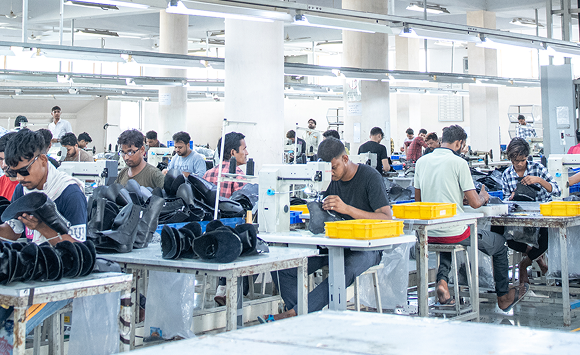
At FOS, pre-shipment AQL 2.5 is the last of 400+ quality checkpoints across a production run. The checkpoints matter more than the gate. In rough sequence:
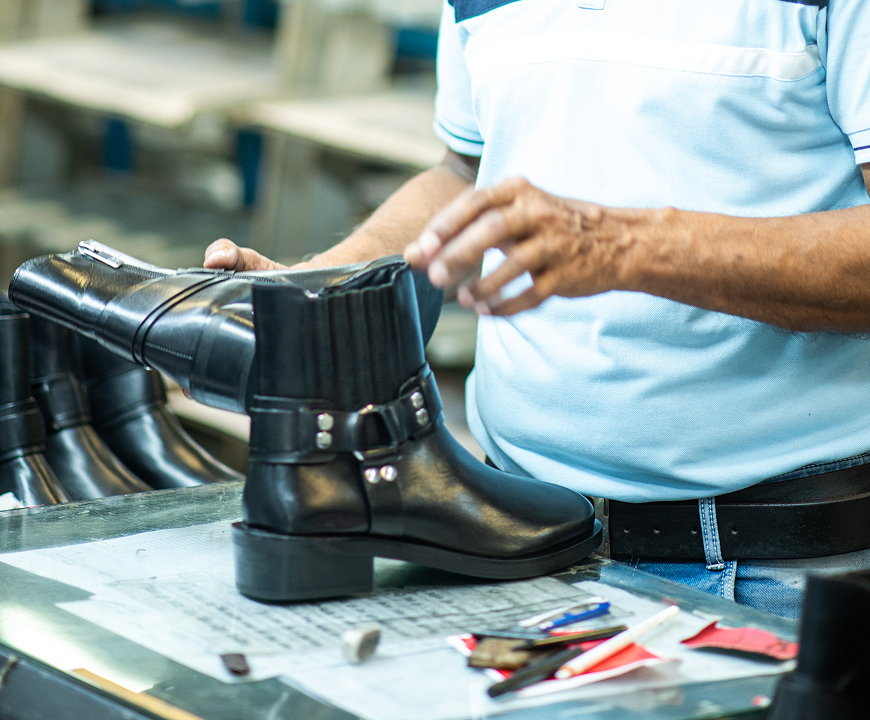
Incoming material. Leather is inspected on arrival for thickness consistency, grain, colour against the approved swatch, and physical properties. Rejecting a hide costs a fraction of rejecting a finished shoe made from it.
Cutting. Cut components are checked against the pattern and inspected for grain direction and defect placement — a natural mark that is acceptable on a hidden quarter is not acceptable on a toe cap.
Closing. Stitch density, seam alignment, thread tension and edge finish are checked in-line, not at the end. A closing fault caught at the machine is a two-minute correction; the same fault found at pre-shipment is a rejected batch.
Lasting and bottoming. Sole adhesion is where the majority of costly footwear failures originate. Bond strength, cement application and pressing are checked systematically, and adhesion is destructively tested on samples pulled from the run.
Finishing and packing. Pairing, size marking, carton marking, and the specific packing method the customer has specified.
Pre-shipment AQL 2.5. The independent gate, on the packed goods.
The point of the sequence is that each stage catches its own errors while they are still cheap. A factory that runs 400+ in-process checks and then inspects at AQL 2.5 is using AQL as confirmation. A factory that only inspects at the end is using it as a lottery.
Questions worth asking a prospective manufacturer
If you are assessing an OEM or ODM footwear supplier, these five questions separate a real quality system from a claim.
- “What happens before the AQL inspection?”
If the answer is vague, the AQL number is decoration. Ask for the checkpoint list. - “Who inspects — your own QC, or a third party?” Both are legitimate. In-house QC gives faster feedback loops; third-party gives independence. What matters is that you know which you are getting, and that you retain the right to appoint your own inspector.
- “What is your defect classification list, and can I see photographs?”
A factory that has one ready has had this conversation before. A factory that improvises one is learning on your order. - “When a batch fails, who pays, and what is the rework turnaround?”
This is the commercially decisive question and it is the one most buyers forget to ask until it is too late. - “Can I see the inspection report from a recent run for another customer, redacted?”
The willingness to show the format tells you whether reports actually exist.
How this connects to lead time
There is a direct line between quality discipline and delivery reliability, and it is not obvious until you have missed a season.
A batch rejected at pre-shipment does not just cost rework. It costs the shipping slot. On a 60–90 day production TAT with sea freight to the UK or EU behind it, a failed inspection can push a delivery past the retail window it was made for. The shoes may eventually be perfect and still be worthless.
This is why FOS treats 98% on-time delivery (internally tracked) and the 400+ checkpoint system as the same programme rather than two separate metrics. Consistent quality is what makes consistent delivery possible. A factory that regularly scrapes through AQL is a factory that will eventually miss your date.
FAQs
- Does AQL 2.5 mean 2.5% of my shoes will be defective?
No. AQL 2.5 is a sampling threshold, not a promised defect rate. It means the inspection plan is calibrated to reject batches whose true defect rate materially exceeds 2.5%. A well-run production line typically delivers far below that. - Who chooses the AQL level — the brand or the factory?
The brand. AQL is a customer specification. Most established footwear buyers specify 2.5 for major defects and zero for critical defects. If a factory tells you the level is fixed and not negotiable, that is a flag. - What happens if a batch fails inspection?
The batch is rejected as a whole and either reworked, 100% sorted, or replaced, depending on the defect and what your purchase order specifies. Agree the commercial consequence — who pays, and what the rework turnaround is — before production starts, not after a failure. - Is in-house QC as good as third-party inspection?
They do different jobs. In-house QC catches faults during production, when correction is cheap. Third-party inspection provides independent verification at the gate. A strong supply chain uses both, and the buyer should always retain the right to appoint their own inspector. - How many quality checkpoints should a footwear factory have?
There is no standard number, and a headline count means little on its own. What matters is coverage: incoming material, cutting, closing, lasting, bottoming, finishing and packing should each have defined checks with recorded results. FOS operates 400+ checkpoints across a production run, with pre-shipment inspection at AQL 2.5. - Does AQL apply to samples as well as bulk?
No. Sampling is a different process — sample approval is a direct one-to-one assessment against the brief, not a statistical inspection. FOS works to a 2–3 week sampling turnaround, with bulk production following at a 60–90 day TAT from confirmed specification.
Written by Sumit Joshan, Managing Director, Foot On Shoes. Foot On Shoes has manufactured women’s leather footwear in Agra, India since 1981, producing 1,800–2,000 pairs a day for brands and retailers across the UK, EU, USA and Japan.
See how quality control fits into the wider production process on our footwear manufacturing page.
Ready to Create With Us?
Let’s discuss how Foot on Shoes can bring speed, and scale to your next collection.
Join Our Exclusive Community
Subscribe to our newsletter for the latest collections and exclusive offers tailored for you.
By clicking Subscribe, you agree to our
Terms and Conditions.