Can You See Your Order in Production? Why Sourcing Directors Should Ask
Last updated:
- September 15, 2026
Key Takeaways
- Most footwear delivery failures are not sudden. They are visible in the factory weeks before the buyer is told.
- The question that predicts supplier reliability best is not “what is your on-time delivery rate” — it is “can you tell me what stage my order is at right now?”
- A factory running on ERP can answer in minutes. A factory running on spreadsheets and WhatsApp answers after it has phoned the floor.
- Foot On Shoes runs production on ERPNext with real-time stage tracking, which is what makes an internally tracked 98% on-time delivery figure meaningful rather than aspirational.
Why “98% on-time delivery” is not the useful question
Every manufacturer quotes an on-time delivery figure. Almost none of them can show you how it is calculated, and the definition does most of the work.
Ask three follow-up questions and the number usually dissolves:
- On time against which date — the original PO date, or the date after the last revision? Most quoted figures use the revised date, which makes the metric close to meaningless.
- Measured at which point — ex-factory, port of loading, or delivered? Ex-factory is the easiest and the least useful to you.
- Counted how — by order, by line, by pair? An order 90% shipped on time and 10% short can be counted either way.
Foot On Shoes tracks 98% on-time delivery internally, measured against the confirmed date, and we describe it that way deliberately — it is our own operational figure, not a third-party certification. What makes it credible is not the number. It is that the system producing it can be interrogated at any moment.
A supplier who can show you the current state of your order does not need you to trust their historic average.
What real-time production visibility actually means
“We use an ERP” is now a standard claim, and it covers a wide range of realities. What matters is whether the system is where work is recorded as it happens, or where someone types up what happened last week.
At FOS, production runs on ERPNext, and an order moves through defined stages that are updated at the point of work:
Material issue. Leather and components are allocated against the specific work order. If a material is short, it is visible as a shortage against your order, not as a general stores problem.
Cutting. Components cut and counted against the size curve. This is the earliest reliable read on whether the run is on schedule.
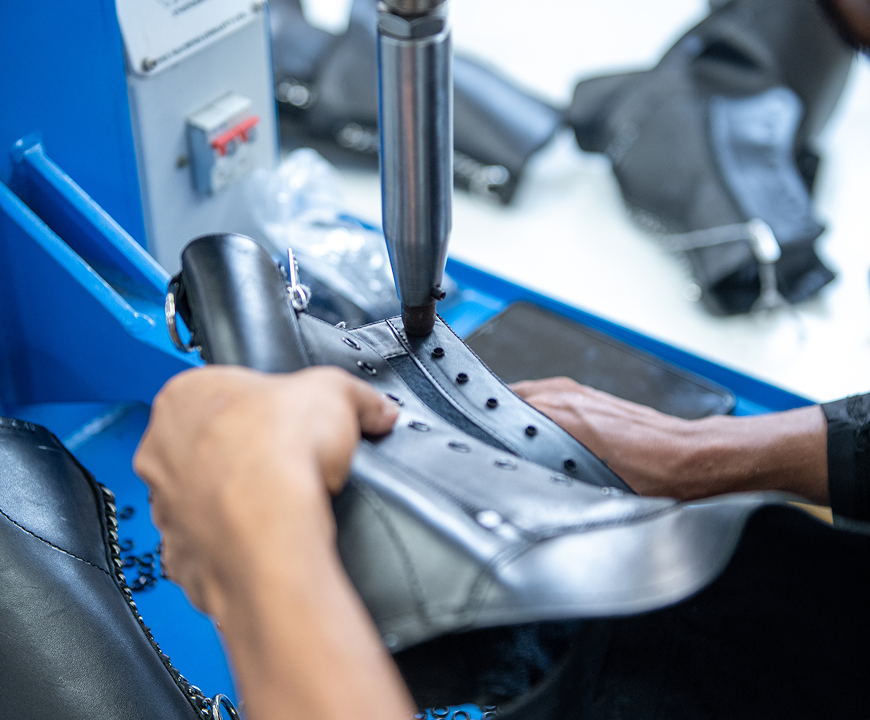
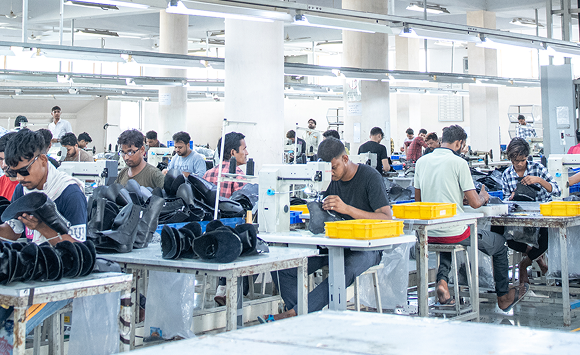
Closing. Uppers stitched. Closing is usually the longest stage and the one most likely to absorb a delay quietly.
Lasting and bottoming. Uppers lasted, soles attached. Adhesion testing happens here.
Finishing. Cleaning, dressing, quality sorting.
Packing. Cartons made up against the shipping marks.
Pre-shipment inspection. AQL 2.5 on the packed goods.
Because each transition is recorded when it occurs, the position of any order is known continuously rather than reconstructed on request. That is the whole difference. It is not a sophisticated capability — it is a discipline about when data is entered.
What this changes for the buyer
Slippage surfaces in days, not weeks. If cutting completes three days behind plan, that is visible immediately as a variance, not seven weeks later as a delivery failure.
Partial-shipment decisions become possible. If four of six colourways are packed and two are held on a material issue, you can decide whether to ship what is ready. You can only make that call if you know it.
Capacity questions get honest answers. Running at 1,800–2,000 pairs a day, we can see what is committed and what is free. When a buyer asks whether an additional 2,000-pair drop can be added in September, the answer comes from the production schedule rather than from optimism.
Quality data attaches to the order. With 400+ quality checkpoints recorded across a run, a rejection at pre-shipment can be traced to the stage where it originated. That is how the same fault stops happening on the next order, rather than being re-discovered.
The question to ask, and how to read the answer
When you are assessing a prospective OEM or ODM footwear manufacturer, ask this:
“Take an order you are running right now for another customer. Without calling anyone, tell me what stage it is at and whether it is on schedule.”
The answer is diagnostic, and it does not require the supplier to breach anyone’s confidence — no customer name, no product, just the stage and the variance.
- Answered in minutes, with a stage and a date variance — the system is real and in use.
- “I’ll check and come back to you” — the data exists somewhere but is not live. Expect week-scale reporting lag.
- “Everything is on schedule” without checking — there is no system. You will find out about problems when they become deliveries.
Then ask the follow-up: “What will I see, and how often, once my order is in production?” Get the answer in writing in the purchase order. Reporting cadence is a specification like any other, and it costs nothing to agree up front.
Visibility is not a substitute for capability
A caveat worth stating plainly, because the technology argument gets overplayed.
Production tracking does not make shoes. A factory with a good ERP and poor lasting will produce well-documented rejects. Systems tell you where the order is; they do not tell you whether the people running the line know what they are doing.
Visibility matters because it is the multiplier on everything else. In-house production with no subcontracting means there is one place to look. 400+ quality checkpoints mean there is something meaningful to record. A 60–90 day production TAT from confirmed specification means there is a plan to measure against. The tracking system makes those facts checkable rather than claimed — which, for a sourcing director choosing between suppliers on the other side of the world, is most of what they were asking for.
FAQs
- What production tracking system does Foot On Shoes use?
Production runs on ERPNext, with orders tracked through defined stages — material issue, cutting, closing, lasting and bottoming, finishing, packing and pre-shipment inspection — updated at the point of work rather than reconstructed afterwards. - How often will I get updates on my order?
Reporting cadence is agreed as part of the purchase order. Because stage data is recorded as work happens, the current position of an order can be provided at any point rather than only at scheduled checkpoints. - How is the 98% on-time delivery figure calculated?
It is measured internally against the confirmed delivery date. It is an internally tracked operational metric, not a third-party certified figure, and we describe it that way deliberately. - Why does it matter whether a factory subcontracts?
Subcontracted work sits outside the manufacturer’s own production system. If part of your order is made elsewhere, nobody can give you an accurate stage report on it, and the quality and labour standards you audited may not apply to it. Foot On Shoes produces entirely in-house. - Can I visit the factory to verify this?
Yes. Buyers and their appointed auditors are welcome at the Agra facility. Foot On Shoes is SEDEX/SMETA audited and SA8000 certified, and holds ISO 9001, HIGG and RCS certifications. - What is the earliest sign that an order is running late?
Cutting completion against the size curve. It is the first stage where planned and actual output can be compared meaningfully, and a variance there is the most reliable early warning of a delivery slip.
Written by Sumit Joshan, Managing Director, Foot On Shoes. Foot On Shoes has manufactured women’s leather footwear in Agra, India since 1981, at a capacity of 1,800–2,000 pairs a day.
More on production process, capacity and lead times on our footwear manufacturing page. To discuss an order, contact solutions@fos.co.in or +91-9719-001-004.
Ready to Create With Us?
Let’s discuss how Foot on Shoes can bring speed, and scale to your next collection.
Join Our Exclusive Community
Subscribe to our newsletter for the latest collections and exclusive offers tailored for you.
By clicking Subscribe, you agree to our
Terms and Conditions.