How Sourcing Directors Verify Ethical Footwear Manufacturing (Before They Place an Order)
Last updated:

Key Takeaways
- Ethical and environmental claims mean nothing without an audit trail — sourcing directors should ask for the specific certifications, their scope, and their dates, not a general statement of values.
- The credentials that matter for UK/EU compliance are SEDEX/SMETA (social audit), SA8000 (labour standard), ISO 9001 (quality management), Higg (environmental performance) and RCS (recycled content), plus REACH-compliant materials.
- Verify three things beyond the certificate: whether production is kept in-house (subcontracting is where audits break down), how energy is sourced, and whether the factory can produce records on request.
- Ask for evidence at the sampling stage, not after the order — a credible manufacturer will have it ready.
Ethical sourcing has moved from a nice-to-have to a board-level requirement. UK and EU retailers now carry due-diligence obligations that reach right back into the factory, which means the person choosing a footwear supplier is also, in effect, underwriting that supplier’s labour and environmental practices. The problem is that “ethical” and “sustainable” are unregulated words. This guide sets out how an experienced buyer separates a real audit trail from a marketing paragraph.
Why is verifying ethical manufacturing now the buyer's responsibility?
Because the risk has shifted upstream. When a retailer faces questions about labour conditions or chemical compliance, “our supplier told us it was fine” is no longer a defence. Modern due-diligence expectations — and the audits your own customers run on you — require documented evidence from the factory that made the goods.
That changes what a sourcing conversation should sound like. Instead of “are you ethical?” (to which every supplier says yes), the useful questions are “which certifications do you hold, what is their scope, when were they last audited, and can I see them?” A manufacturer that treats compliance as core will answer without hesitation. One that treats it as marketing will change the subject.
Which certifications actually matter for footwear?
Not all certifications carry the same weight, and some are more relevant to footwear than others. The ones that do the work for a UK/EU buyer:
- SEDEX / SMETA — the social-compliance backbone. SMETA is an audit methodology covering labour standards, health and safety, environment and business ethics; SEDEX is the platform that stores and shares the results. This is usually the first document a retailer’s compliance team asks for.
- SA8000 — an internationally recognised standard specifically for decent working conditions: no child or forced labour, freedom of association, fair working hours and pay. It is a labour-rights standard, and it is audited.
- ISO 9001 — quality management systems. It tells you the factory runs on documented, repeatable processes rather than personalities — which is also what makes ethical practices consistent rather than occasional.
- Higg — an environmental performance framework from the Sustainable Apparel Coalition, used to measure a facility’s environmental footprint on a comparable basis.
- RCS (Recycled Claim Standard) — verifies recycled content in materials, so a “recycled” claim on a component can actually be substantiated.
- REACH compliance — the EU chemicals regulation. For leather footwear this matters enormously: it governs restricted substances in tanning, adhesives and finishes. REACH-compliant materials keep your product legal to sell in the EU.
Foot On Shoes holds SEDEX/SMETA, SA8000, ISO 9001, Higg and RCS, and works to REACH-compliant materials. Note what is not on that list: we do not claim certifications we do not hold. That distinction is itself a signal — a supplier who over-claims on certification is telling you how they will handle the next uncomfortable question.
What should you check beyond the certificate itself?
A certificate is a snapshot. Three things tell you whether the practice behind it is real:
1. Is production kept in-house?
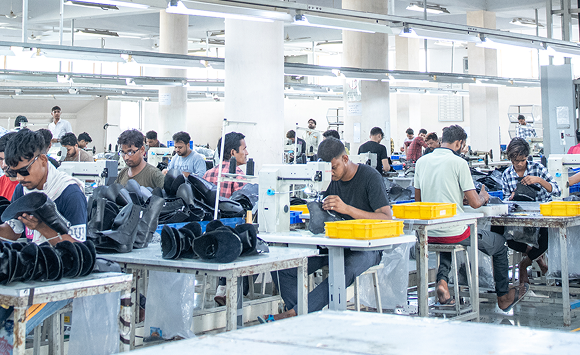
Subcontracting is where most ethical audit trails collapse. If a factory quietly farms out lasting, stitching or finishing to unaudited units, the certifications on the front door no longer describe the goods in your container. Ask directly: is any part of production subcontracted? We keep production in-house, which is what allows our internally tracked 98% on-time delivery — and, just as importantly, means the audited factory is the one that actually makes your shoes.
2. How is energy sourced?
Environmental credibility is easiest to verify through energy. Ask what proportion of operational energy is renewable and how it is generated on site. Around 41% of our operational energy comes from solar — a figure that is measurable and specific, which is exactly the kind of claim you should expect rather than a vague “we care about the planet”.
3. Can they produce records on request?
The final test is responsiveness. A factory with genuine systems can pull an audit report, a compliance certificate or a materials declaration when asked. If every request triggers a delay and a rewritten PDF, treat that as your answer.
When in the process should you ask for this?
At sampling, not after the order. Buyers routinely leave compliance to the end, treat it as paperwork, and then discover a problem when the goods are already in production. Front-load it:
- Request the certification pack when you request the first sample.
- Confirm materials are REACH-compliant before the bill of materials is locked, because substituting a non-compliant adhesive or finish after approval is expensive and slow.
- Build the compliance check into your development calendar — it costs nothing when done early and a great deal when done late.
A capable manufacturer expects this and has the pack ready. Our sampling runs on a 2–3 week turnaround, and the compliance evidence travels with the sample rather than trailing behind the order.
How does ethical manufacturing connect to quality and reliability?
They are the same discipline seen from different angles. A factory that documents its labour practices tends to document its quality processes too — the same management system that satisfies SA8000 also underpins our 400+ QC checkpoints and AQL 2.5 pre-shipment standard. Keeping production in-house serves ethics and on-time delivery. Renewable energy and waste discipline come from the same operational rigour that produces a consistent shoe.
In other words, ethical manufacturing is not a separate department you are auditing — it is a symptom of whether the whole operation is run properly. Which is why the buyers who verify it thoroughly tend to get better product as well as a cleaner conscience.
The bottom line
Treat ethical and sustainable claims the way you would treat a costing: ask for the numbers, ask for the scope, ask for the date. Insist on named certifications rather than sentiments — SEDEX/SMETA, SA8000, ISO 9001, Higg, RCS and REACH-compliant materials for footwear. Verify that production stays in-house, that energy is measurably sourced, and that records appear when requested. Do it at sampling, and the answer protects both your brand and your customer’s trust.
Foot On Shoes is a third-generation OEM/ODM manufacturer of women’s leather footwear, founded in Agra in 1981, exporting to the UK, EU, USA and Japan. To request our compliance pack, contact solutions@fos.co.in or +91-9719-001-004.
FAQs
What is the difference between SEDEX and SMETA?
SMETA is the audit methodology — the actual assessment of labour, health and safety, environment and ethics. SEDEX is the membership platform that stores and shares those audit results with your customers. Buyers usually ask for a current SMETA report held on SEDEX.
Is SA8000 the same as an ISO standard?
No. SA8000 is a social accountability standard focused specifically on working conditions and labour rights. ISO 9001 is a quality-management standard. They are complementary — one governs how people are treated, the other how processes are controlled.
What does REACH compliance mean for leather footwear?
REACH is the EU regulation on chemical substances. For leather footwear it governs restricted substances in tanning, dyes, adhesives and finishes. REACH-compliant materials keep the finished product legal to sell across the EU.
How can I verify a factory’s sustainability claims?
Ask for measurable specifics — the proportion of renewable energy, the environmental framework used (such as Higg), and recycled-content verification (such as RCS) — rather than general statements. Then ask whether production is kept in-house, since subcontracting undermines any facility-level claim.
When should compliance be checked in the sourcing process?
At the sampling stage, before the bill of materials is locked. Confirming certifications and REACH-compliant materials early avoids costly substitutions once a style is in production.
Ready to Create With Us?
Let’s discuss how Foot on Shoes can bring speed, and scale to your next collection.
Join Our Exclusive Community
Subscribe to our newsletter for the latest collections and exclusive offers tailored for you.
By clicking Subscribe, you agree to our
Terms and Conditions.